
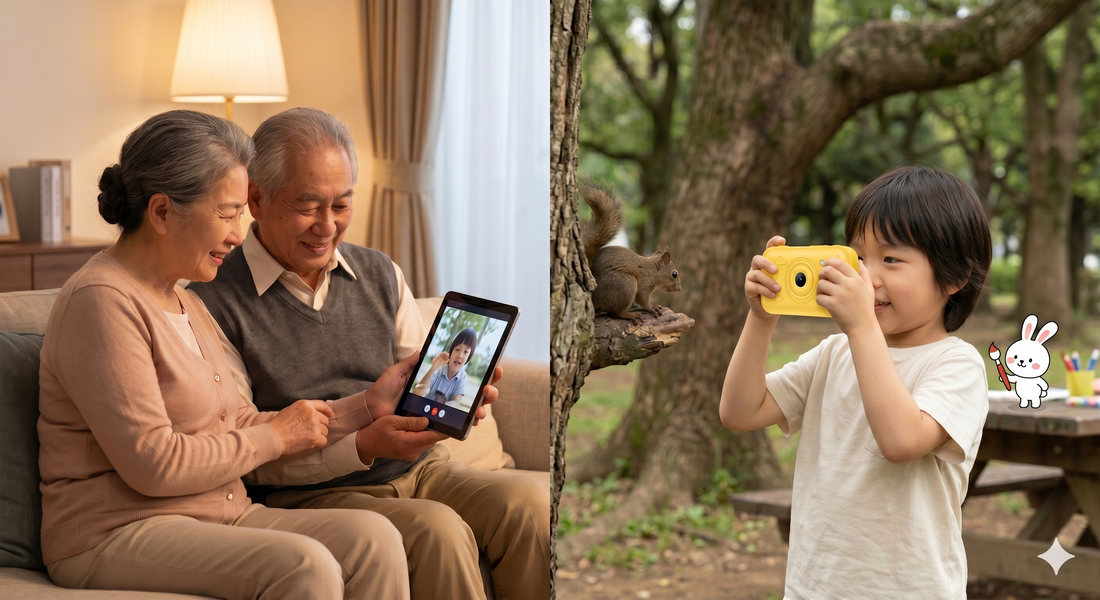
Ask any grandparent who lives far from their grandchildren what the hardest part is, and you'll often hear the same thing: the phone calls run out of steam. "How was school?" "Fine." "What did you do today?" "Nothing." It isn't that the love is missing — it's that the awareness is. When you don't know what someone's days actually look like, it's genuinely hard to find something to talk about. The Jumpo AI Camera, and its family sharing feature in particular, was designed to solve exactly that problem.
The Real Problem With Long-Distance Relationships
Distance doesn't break relationships on its own. What wears them down is the slow loss of shared context — the small, everyday details that close-by family members pick up without trying. A grandparent who lives down the street knows their grandchild found a frog in the garden, lost a tooth on Tuesday, and has been obsessed with dinosaurs for three weeks. A grandparent two time zones away knows none of that, so every conversation has to start from zero.
That's the heart of it: when there's no awareness of what the other person has been doing, there's very little surface area for a conversation to grab onto. Both sides want to connect, but neither has a thread to pull. The result is the polite, empty back-and-forth that leaves everyone feeling like the call was nice but didn't really land.
Seeing the World Through a Child's Eyes
Here's what makes Jumpo different. The camera belongs to the child, and the photos are the child's photos — taken from their height, of the things they found interesting. A grandparent isn't looking at carefully staged family portraits an adult chose to send. They're seeing the squirrel that stopped a six-year-old in their tracks, the puddle that was apparently the most important thing in the world that morning, the slightly blurry photo of a friend's shoes.
With family sharing turned on, those photos flow automatically into the grandparent's own Jumpo app. They don't have to ask, and the parents don't have to remember to forward anything. The camera's built-in cellular connection means pictures arrive on their own, so a relative on the other side of the world quietly becomes part of the everyday — not just the big occasions.
Every Photo Is a Conversation Starter
This is where the magic happens. Each photo gives a distant relative something specific and real to talk about — a ready-made doorway into the child's world. Instead of "How was your day?", the conversation can begin with something the child actually cares about.
Imagine a few of these moments:
- The squirrel. Your grandchild snaps a photo of a squirrel in the park. The next time you call, instead of a generic opener you say, "I saw you spotted a squirrel the other day — can you tell me about it? Was it eating something? Did it run up a tree?" Suddenly the child lights up, because you're asking about their thing.
- The tower of blocks. A photo of a wobbly block tower becomes, "That tower looked so tall! How many blocks did you use? Did it fall down in the end?"
- The new shoes. A close-up of bright new sneakers gives you, "I love your new shoes — are they good for running fast? Did you try them out at school?"
- The drawing on the fridge. A snapshot of a crayon masterpiece turns into, "Tell me about the picture you drew — is that our dog? What color did you make the sky?"
- The half-eaten breakfast. Even a photo of pancakes becomes, "Those pancakes looked delicious! Did you put syrup on them? Who made breakfast today?"
None of these are big events. That's the point. The ordinary moments are what build a relationship, and Jumpo makes the ordinary visible to someone who would otherwise miss all of it.
Why This Matters More Than It Seems
Children open up when they feel known. A grandparent who can ask about the specific squirrel, the specific tower, the specific drawing isn't just making small talk — they're showing the child that their world is interesting and worth paying attention to. Over time, that's how a long-distance grandparent goes from being "the person on the screen" to a real, present part of a child's life.
It changes the calls in both directions, too. The child has something to show and tell, and the grandparent has something genuine to ask. The conversation has fuel. And because the photos keep arriving day after day, there's always a fresh starting point — you're never reaching back to the last holiday for something to discuss.
Built for Grandparents Who Aren't "Tech People"
A common worry is whether an older relative will actually be able to use it. Jumpo's family sharing is built to be effortless on their end. A parent — the Device Owner — sends an invitation to the relative's email and assigns them a family role, like Grandma or Grandpa. Once they accept, they become a Device Viewer: they can see all the photos in their own app, but they don't have to manage settings, subscriptions, or anything technical. They simply open the app, and the latest pictures are waiting.
That simplicity is deliberate. The whole experience is designed so a grandparent can focus on the grandchild, not on figuring out an app. And because parents stay in full control of who's invited and can adjust access at any time, the family circle stays exactly as wide as you want it.
A Window That Stays Open
Photos sent by text get lost in the scroll. A shared photo album in the Jumpo app is different — it's a living window into a child's world that stays open all the time. A grandparent can glance at it over morning coffee and feel close, even from thousands of miles away. They can watch the seasons change in the background of the photos, notice a new front tooth coming in, see the same favorite toy show up again and again.
That continuity is what distance usually steals. Jumpo gives it back. The relationship stops being a series of disconnected phone calls and becomes something ongoing — a quiet, daily thread of being part of each other's lives.
The Bottom Line
The hardest part of loving a child from far away isn't the distance itself — it's not knowing the small stuff that makes up their days. Jumpo's family sharing closes that gap. By letting grandparents and distant relatives see the world through a child's own camera, it hands them exactly what every meaningful conversation needs: something real to talk about. The squirrel in the park becomes a story shared across an ocean. And that's how a long-distance relationship stays close.


